Generative AI consulting services: the complete guide for 2026
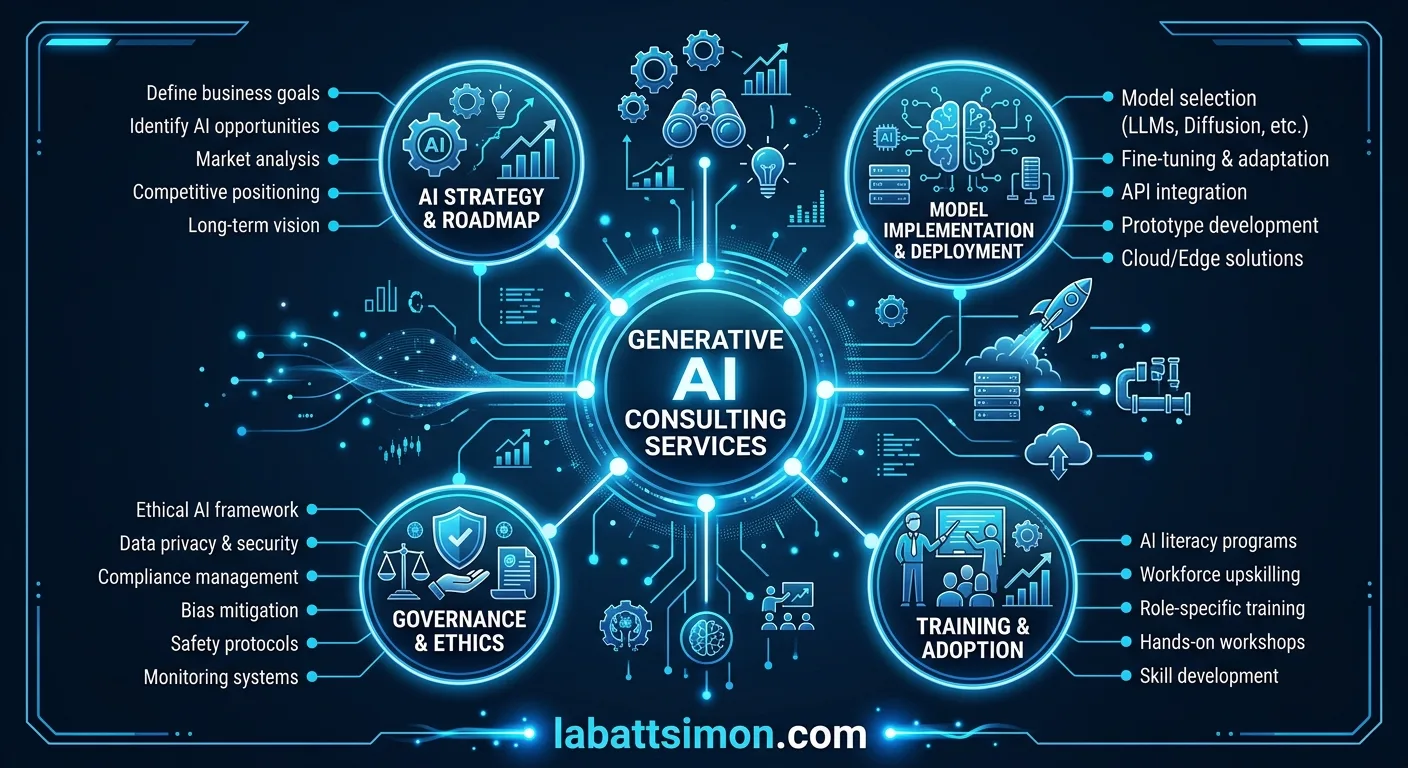
Generative AI consulting services help organizations plan, build, and scale AI systems that produce text, images, code, and other content using large language models and foundation models. These services typically include strategy development, use case identification, pilot development, model selection, data preparation, deployment, and ongoing optimization. In 2026, with 88% of organizations using AI in at least one business function (McKinsey, 2025) but only 6% qualifying as "AI high performers," the gap between companies experimenting with AI and those actually capturing value has never been wider. A qualified generative AI consultant bridges that gap by translating raw technology capability into measurable business outcomes.
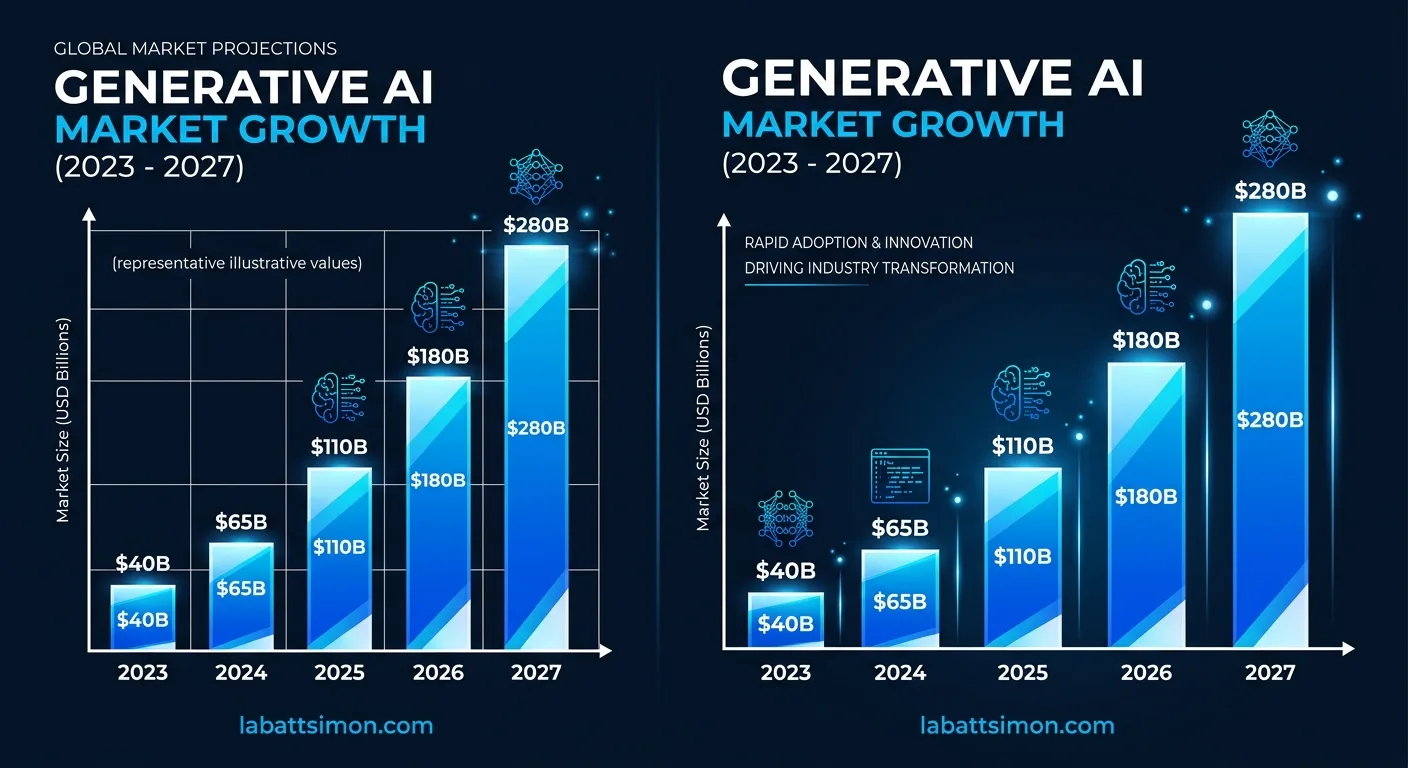
If you have been evaluating whether to bring in outside expertise for your AI initiatives, you are not alone. Enterprise spending on generative AI reached $37 billion in 2025, a 3.2x increase from the prior year (Menlo Ventures). Yet the uncomfortable truth remains: roughly 95% of enterprise AI pilots deliver zero measurable P&L impact, according to research from MIT. The organizations that break through share a common thread. They work with experienced advisors who understand both the technology and the business context needed to make it stick.
This guide covers everything you need to know about generative AI consulting: what these services actually include, how much they cost, how to evaluate consultants, when to build internally versus buying external help, realistic implementation timelines, industry-specific applications, and how to measure whether your investment is paying off.
What generative AI consulting services actually include
The phrase "generative AI consulting" gets thrown around loosely. Some firms use it to describe a two-hour strategy call. Others mean a six-month, full-stack implementation engagement. Understanding what falls under this umbrella helps you compare vendors and set expectations before signing anything.
Strategy and roadmap development
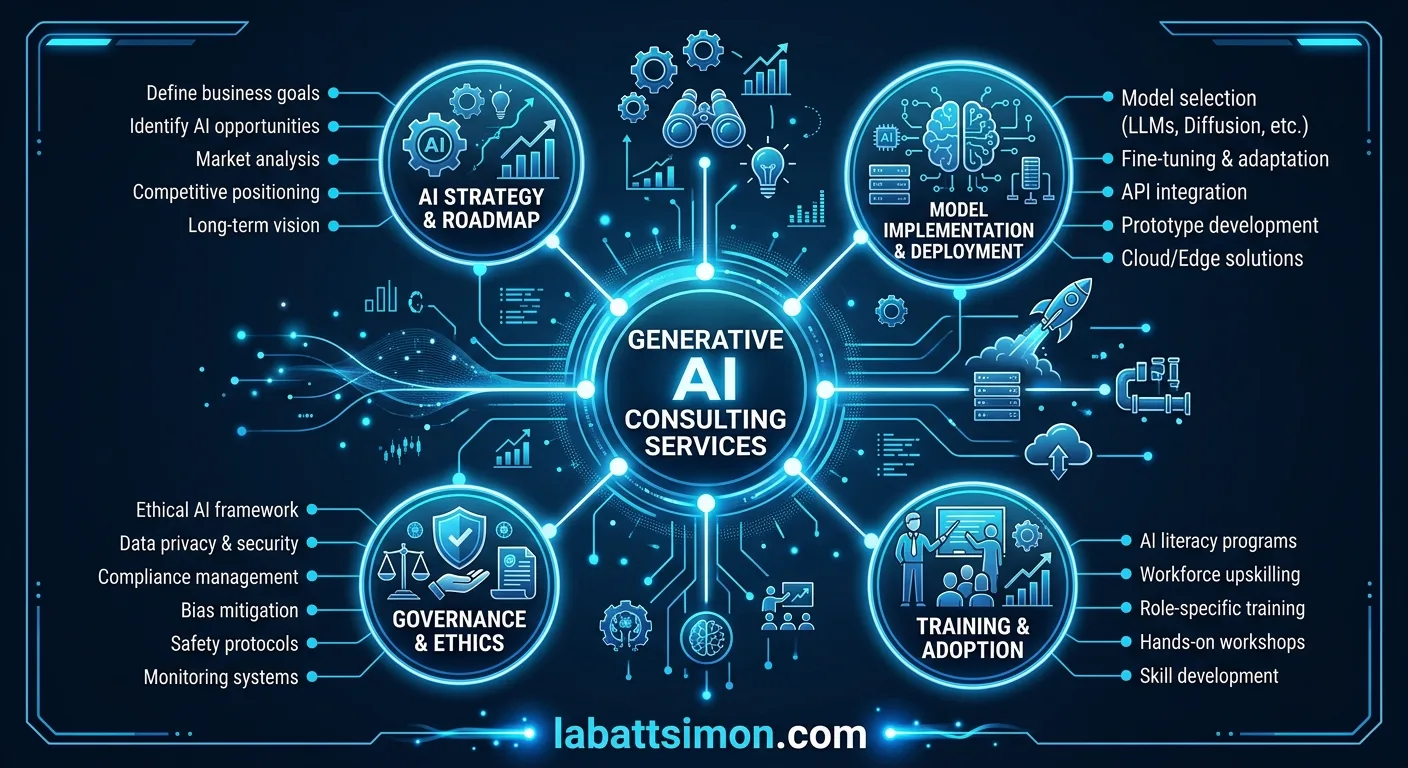
This is where most engagements begin. A consultant assesses your current AI maturity, maps business processes where generative AI could create value, and builds a prioritized roadmap. The deliverable is typically a strategy document that includes 3 to 5 high-impact use cases scored by feasibility, value potential, and time to results.
Good strategy work goes beyond identifying where AI could help. It includes an honest assessment of your data readiness, infrastructure gaps, team capabilities, and organizational appetite for change. Deloitte's 2026 State of AI in the Enterprise survey found that the AI skills gap is the single biggest barrier to integration, ahead of budget constraints and technology limitations. A consultant who skips the organizational assessment is setting you up for a pilot that never reaches production.
Use case identification and prioritization
Not every promising AI application deserves your investment. The best consultants bring structured scoring frameworks that weigh revenue impact, cost reduction potential, data availability, technical complexity, and regulatory friction against each other. This prevents the common mistake of chasing the most technically interesting project rather than the most commercially valuable one.
McKinsey's 2025 State of AI survey showed that high-performing organizations deploy AI across three or more business functions, not in isolated experiments. A consultant should help you see the portfolio of opportunities, not just the single use case that caught your CEO's attention after a conference keynote.
Proof of concept and pilot development
Once you have a roadmap, the next step is building something real. Consultants design and develop targeted pilots, usually scoped to 8 to 16 weeks, that validate whether a specific AI application works with your actual data, in your actual systems, for your actual users.
The pilot phase is where the rubber meets the road. Success metrics should be defined before development begins, including time saved per task, error rate reduction, throughput improvements, and user adoption rates. A well-run pilot should produce enough evidence to make a confident go or no-go decision about scaling.
Model selection and architecture design
Generative AI has moved far beyond "just use ChatGPT." In 2026, consultants help organizations navigate choices between foundation models (GPT-4, Claude, Gemini, Llama, Mistral), retrieval-augmented generation architectures for enterprise knowledge access, fine-tuned domain-specific models for regulated industries, and agentic AI systems that can reason through multi-step workflows.
The architecture decisions made at this stage have long-term consequences for cost, performance, security, and vendor lock-in. A consultant who can explain why one approach fits your situation better than another is the one you want on the project.
Data preparation and governance
Almost every AI project runs into data quality issues. One industry analysis found that 99% of AI and ML projects encounter data quality problems, and poor data quality costs organizations $12.9 million annually. Consultants help by auditing existing data sources, designing cleaning and normalization pipelines, implementing metadata and access controls, and building the governance frameworks that keep AI systems compliant as they scale.
Deployment, integration, and ongoing optimization
Getting a model working in a demo environment is very different from embedding it into production business systems. Consultants handle API integration with existing enterprise software, security hardening, performance monitoring, model retraining schedules, and the operational handoff to internal teams.
The best engagements include a knowledge transfer plan so your team can eventually maintain and improve the system without ongoing external dependency.
Service tiers and pricing for generative AI consulting
AI consulting costs vary dramatically based on the firm type, consultant seniority, project scope, and pricing model. Here is what the market looks like in 2026, based on aggregated industry data.
Pricing by engagement type
Engagement Type | Independent Consultant | Boutique AI Firm | Big 4 / Strategy Firm |
|---|---|---|---|
Hourly rate | $150 to $350/hr | $250 to $450/hr | $350 to $500+/hr |
Daily rate | $1,000 to $2,500/day | $1,500 to $3,000/day | $2,500 to $3,500+/day |
AI strategy assessment | $10,000 to $30,000 | $25,000 to $80,000 | $50,000 to $150,000+ |
Proof of concept / pilot | $20,000 to $60,000 | $50,000 to $150,000 | $100,000 to $300,000+ |
Full AI implementation | $50,000 to $150,000 | $150,000 to $500,000 | $500,000 to $2,000,000+ |
Monthly retainer | $3,000 to $10,000/mo | $10,000 to $25,000/mo | $25,000 to $50,000+/mo |
Sources: Leanware 2026 AI Consulting Cost Guide, Nicola Lazzari AI Consultant Pricing US 2025, Orient Software AI Consulting Rate Breakdown, Digital Agency Network AI Agency Pricing Guide 2026.
The three main pricing models
Hourly billing is the most straightforward. You pay for the consultant's time, typically in 15 or 30 minute increments. Junior consultants (0 to 3 years experience) charge $100 to $150 per hour. Mid-level consultants (3 to 7 years) run $150 to $300. Senior experts (7+ years) command $300 to $500 or more, with generative AI specialists adding a 20 to 30% premium on top of base rates.
Project-based pricing gives you budget certainty. The consultant quotes a fixed fee for defined deliverables and timeline. Small projects run $10,000 to $50,000. Medium projects (custom model development, data pipeline setup) range from $50,000 to $250,000. Enterprise-scale implementations start at $250,000. For smaller companies, see our guide on AI consulting for small businesses and can exceed $1,000,000.
Retainer models work well for ongoing advisory relationships. Basic advisory retainers (5 to 10 hours per month) cost $2,000 to $5,000 monthly. Standard support retainers (10 to 25 hours) run $5,000 to $15,000. Comprehensive partnerships with dedicated teams start at $15,000 and can exceed $50,000 per month.
A growing trend in 2026 is value-based pricing, where a portion of the consultant's fee is tied directly to measurable business outcomes. This typically structures compensation as 10 to 25% of documented cost savings or revenue increases. According to recent research, 73% of consulting clients now prefer pricing models tied to measurable outcomes rather than time spent.
What drives cost variation
The biggest factor is project complexity. Deploying a chatbot using pre-trained models is a fundamentally different engagement than building a custom multi-agent system integrated with your ERP, CRM, and data warehouse. Geography matters too, though less than it used to. San Francisco and New York consultants command 15 to 30% premiums over the national average, but remote work has narrowed the gap considerably.
How to evaluate generative AI consultants
Not all AI consultants deliver equal value. The market has been flooded with practitioners who completed a few online courses and started calling themselves AI experts. Here is how to separate real expertise from marketing.
Technical depth and breadth
Ask specific technical questions. A qualified consultant should be able to explain the trade-offs between different model architectures, discuss when RAG is appropriate versus fine-tuning, and have hands-on experience deploying models in production environments. Ask about specific projects: What was the use case? What architecture did they choose and why? What went wrong? How did they fix it?
Red flag: a consultant who can only talk about one model provider (usually OpenAI) and frames every problem as a prompt engineering exercise. The field is far more nuanced than that.
Industry and domain experience
AI expertise alone is not enough. A consultant building generative AI systems for healthcare needs to understand HIPAA compliance, clinical workflows, and the regulatory environment for AI in medical settings. Someone working in financial services needs familiarity with AML/KYC requirements, model risk management frameworks, and regulatory expectations around AI-driven decision-making.
McKinsey's research found that high-performing AI organizations are three times more likely to have leaders who take direct ownership of AI initiatives. Your consultant should bring enough domain knowledge to earn credibility with business stakeholders, not just the engineering team.
Track record with production systems
The gap between a working prototype and a production system is enormous. Ask for case studies or references from clients where the consultant's work is actually running in production, handling real traffic, and generating measurable business results. Many consultants have impressive portfolios of proofs of concept that never made it past the demo stage.
Deloitte's 2025 survey of 1,854 executives found that worker access to AI rose by 50% in 2025, and the number of companies with 40% or more of projects in production is set to double in six months. You want a consultant who has actually taken systems through that transition.
Approach to change management
The most technically brilliant AI system is worthless if nobody uses it. Gartner projects that 40% of AI projects will fail by 2027 due to escalating costs, unclear business value, and inadequate risk controls. Ask how the consultant handles organizational change, training, and adoption. Do they have a methodology for getting non-technical teams comfortable with AI tools? Do they build internal capability or create dependency?
Questions to ask before hiring
What percentage of your pilot projects have reached production deployment?
How do you handle situations where the data quality is not sufficient for the proposed use case?
Walk me through your process for defining and measuring ROI on an AI engagement.
What is your approach to knowledge transfer and building internal capability?
How do you structure governance and responsible AI practices in your engagements?
Can you provide references from clients in our industry where your work is currently running in production?
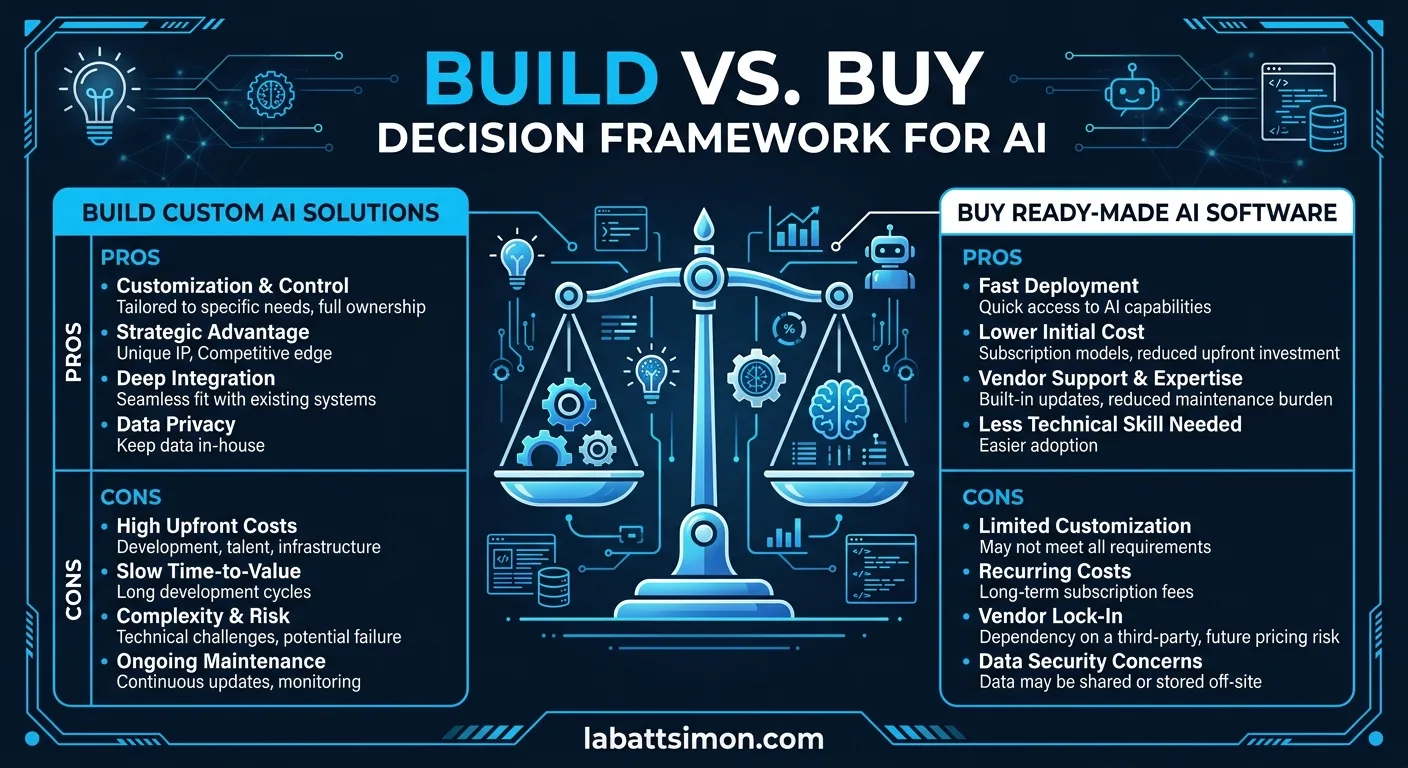
Build vs. buy: when to hire a consultant vs. building in-house
This question comes up in almost every conversation about generative AI strategy. The right answer depends on your current team, how fast you need to move, and where AI fits in your long-term plans.
When external consulting makes sense
You lack internal AI expertise. If you do not have experienced ML engineers, data scientists, or AI architects on staff, building from scratch means hiring, training, and retaining scarce talent before you can even start. The AI skills gap is the number one barrier to integration, according to Deloitte's 2026 survey.
You need to move fast. Experienced consultants can compress timelines significantly. Leaders in generative AI adoption deploy in under three months, while laggards take far longer to move from pilot to production. A consultant who has built similar systems before brings a playbook that shortcuts the learning curve.
Your use case is specialized or high-risk. For regulated industries (healthcare, financial services, government), the consequences of getting AI wrong are severe. External experts who have dealt with compliance requirements in similar contexts reduce your risk substantially.
You want objective evaluation. Internal teams often have biases toward specific technologies or approaches. An outside consultant brings a vendor-neutral perspective and can evaluate options without the political dynamics that shape internal decisions.
When building in-house makes sense
AI is core to your long-term competitive advantage. If generative AI capabilities will be a central differentiator for your product or service, owning the talent and the IP matters. Using consultants for initial acceleration is fine, but the strategic capability should eventually live inside your organization.
You already have strong technical talent. If you have experienced engineers who are ready to learn AI, investing in their development may be more cost-effective than ongoing consultant fees. Combine internal upskilling with targeted consulting for the most complex architectural decisions.
You have ongoing, high-volume AI needs. If you are going to run dozens of AI workloads across your organization, the economics shift in favor of dedicated internal teams over time. The initial investment is higher, but the per-project cost drops significantly at scale.
The hybrid approach
The most common pattern in 2026 is a hybrid model: hire a consultant to set the strategy, build the first pilots, and establish the architecture, then gradually hand off to internal teams as they ramp up. The AmplifAI data supports this: organizations that buy from specialized vendors succeed at double the rate of those building internally, at 67% versus 33%. But "buying" does not mean permanent dependency. The best consultants work themselves out of a job by building your team's capability alongside the technology.
Implementation timeline: what to actually expect
Unrealistic timeline expectations kill AI projects. MIT found that 56% of organizations take 6 to 18 months to move a generative AI project from intake to production. Here is a realistic breakdown based on aggregated industry data.
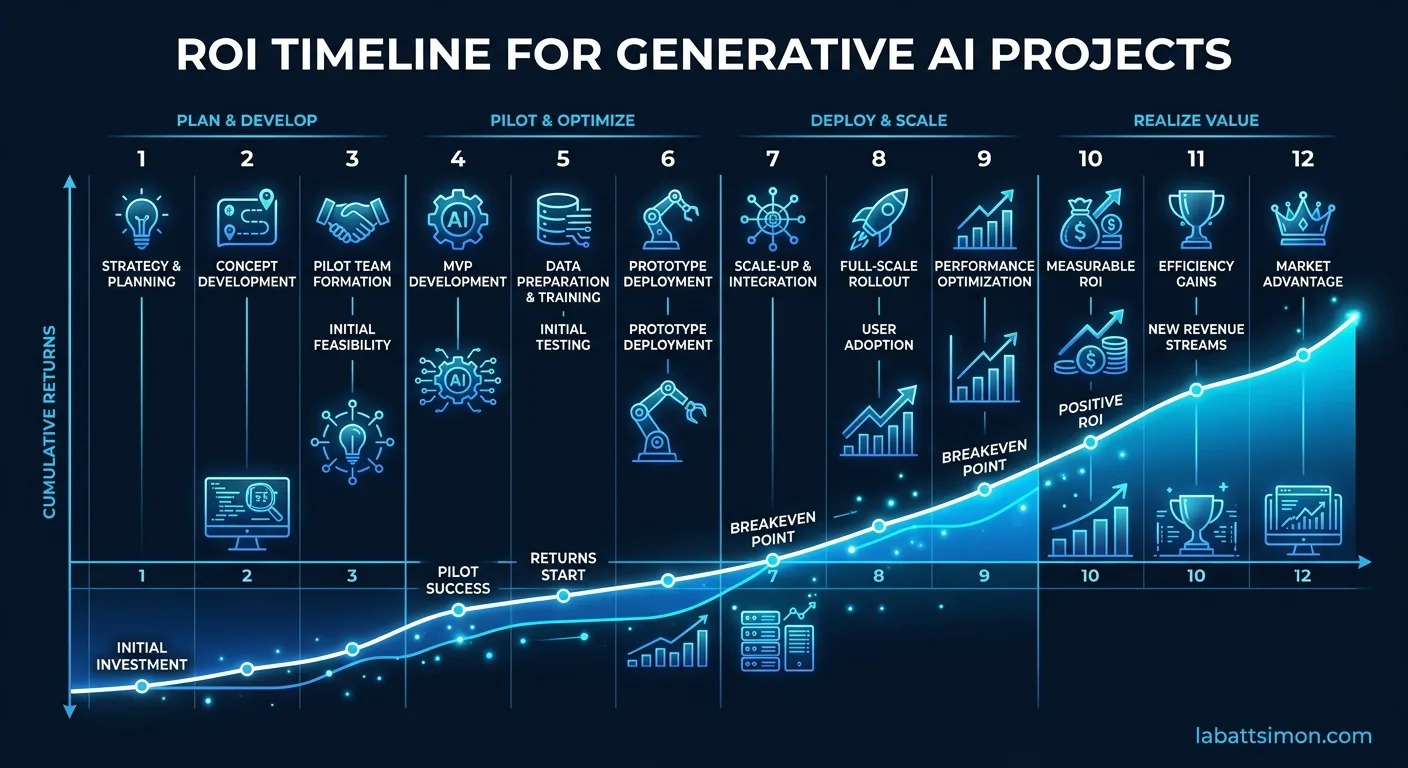
Phase-by-phase timeline
Phase | Duration | Key Activities | Key Deliverables |
|---|---|---|---|
1. Assessment and Strategy | 3 to 6 weeks | AI readiness evaluation, data audit, use case identification, stakeholder alignment | Strategy document, prioritized roadmap, resource plan |
2. Data and Infrastructure Prep | 6 to 12 weeks | Data cleaning, pipeline construction, infrastructure upgrades, governance framework | Production-ready data foundations, security protocols |
3. Pilot Development | 8 to 16 weeks | Model selection, architecture design, prototype build, user testing | Working pilot with defined success metrics |
4. Scaling and Integration | 3 to 6 months | Phased department rollout, API integration, training programs, change management | Enterprise-wide deployment, adoption metrics |
5. Optimization | Ongoing | Performance monitoring, model retraining, cost optimization, capability expansion | Continuous improvement, expanded use cases |
Total timeline for a typical enterprise engagement: 9 to 18 months from assessment to scaled production.
Organizations with clean data, strong executive sponsorship, and existing technical talent can compress this to 6 to 12 months. Complex transformations involving legacy system integration, heavy regulatory requirements, or large distributed organizations may extend to 24 months or beyond.
What speeds things up
Three factors consistently speed up implementation. First, executive sponsorship. McKinsey found that high performers are three times more likely to have senior leaders who actively drive AI adoption. Second, data readiness. Organizations with clean, accessible historical data reduce implementation timelines by up to 40%. Third, focused scope. Starting with one or two high-impact use cases rather than trying to transform everything at once.
What slows things down
The most common delays come from data quality issues (almost universal), unclear business ownership of AI initiatives, change management resistance, and scope creep. One Deloitte finding stands out: education rather than role redesign was the number one way companies adjusted their talent strategies for AI. Organizations that invest in workforce training early in the process face far less resistance during rollout.
Industry-specific use cases for generative AI consulting
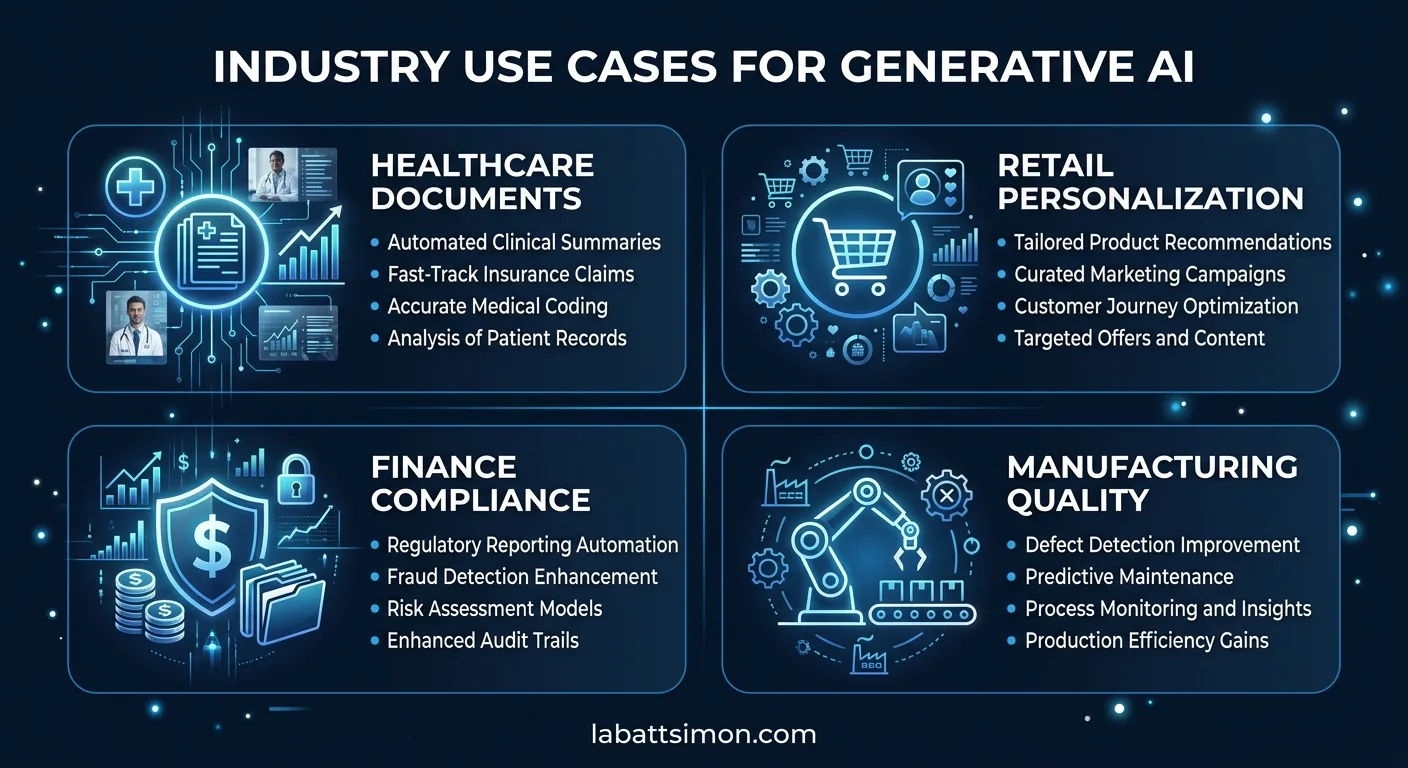
Generative AI applications look very different depending on your industry. Here is where consulting engagements are producing the most measurable results, broken down by four major sectors.
Retail and e-commerce
Retail is one of the fastest-moving sectors for generative AI adoption. Key use cases include:
Personalized product recommendations and content. Generative AI analyzes customer behavior, purchase history, and browsing patterns to produce personalized product descriptions, marketing emails, and recommendation engines that go beyond traditional collaborative filtering.
Dynamic pricing and inventory optimization. AI models process demand signals, competitor pricing, seasonal patterns, and supply chain data to generate pricing recommendations and inventory forecasts. Retailers report 15 to 25% improvements in inventory turnover when AI-driven forecasting replaces manual planning.
Customer service automation. Cisco projects that 56% of customer support interactions will involve agentic AI by mid-2026. In retail, this means AI agents handling order status inquiries, returns processing, product questions, and escalation routing. Companies deploying these systems report 35 to 50% reductions in ticket resolution time.
Visual merchandising and content generation. Retailers use generative AI to produce product photography variations, marketing copy, social media content, and even virtual try-on experiences at a fraction of the cost of traditional creative production.
Healthcare and life sciences
Healthcare has the strictest requirements for accuracy, compliance, and governance, which is exactly why consulting expertise matters so much in this space. Getting it wrong has real consequences for patients.
Clinical documentation and administrative automation. Physicians spend roughly two hours on administrative work for every hour of patient care. Generative AI systems trained on medical terminology can draft clinical notes, summarize patient histories, and pre-populate forms, saving clinicians significant time while maintaining accuracy.
Drug discovery and research synthesis. Pharmaceutical companies use generative AI to analyze research literature, identify potential drug compounds, and synthesize findings across thousands of papers. This accelerates the early stages of R&D pipelines that traditionally take years.
Diagnostic decision support. AI models trained on medical imaging and patient data provide clinicians with supplementary analysis, flagging potential diagnoses and surfacing relevant clinical evidence. These systems require extensive validation and compliance review, which is where consultants experienced in FDA and HIPAA frameworks earn their fees.
Patient engagement and communication. Generative AI powers personalized patient education materials, appointment reminders, post-visit follow-up content, and chronic disease management communications. These systems need careful calibration to avoid generating medical advice that crosses regulatory boundaries.
Financial services
Financial services is where generative AI ROI numbers look the best. Industry data shows the sector achieving 4.2x returns on generative AI investment, the highest of any vertical.
Fraud detection and risk management. Generative AI enhances traditional rule-based fraud detection by identifying novel patterns and generating synthetic training data for rare fraud scenarios. Banks report measurable improvements in fraud detection performance when combining generative models with existing systems.
Regulatory compliance and reporting. Financial institutions face enormous compliance burdens. Generative AI automates AML/KYC processing, generates regulatory reports, summarizes policy changes, and monitors transactions for compliance violations. These systems reduce manual review time while improving coverage.
Client advisory and wealth management. AI generates personalized investment research summaries, market analysis, and client communications tailored to individual portfolio positions and risk profiles. This allows advisors to serve more clients with higher quality, more personalized interactions.
Credit decisioning and underwriting. Generative AI models analyze structured and unstructured data (financial statements, industry reports, news articles) to generate more comprehensive credit assessments. These systems need robust governance and model risk management frameworks, a natural fit for consulting engagements.
Manufacturing and industrial
Manufacturing has been slower to adopt generative AI than knowledge-work sectors, but that is changing fast. Deloitte's survey found that physical AI usage is set to reach 80% of companies within two years.
Predictive maintenance. Generative AI analyzes sensor data, maintenance logs, and equipment specifications to predict failures before they happen and generate maintenance schedules that minimize downtime. Companies report significant reductions in unplanned downtime.
Quality control and defect detection. AI systems trained on visual data identify product defects with consistency that exceeds manual inspection. Generative models can also produce synthetic defect images to train detection systems when real defect data is scarce.
Supply chain optimization. Generative AI processes demand forecasts, supplier performance data, logistics constraints, and market signals to generate optimized supply chain plans. This is especially valuable in complex, multi-tier supply chains where traditional planning tools struggle.
Engineering design and documentation. AI generates initial design iterations, technical documentation, safety analysis reports, and maintenance manuals. Engineers use these as starting points rather than blank-page exercises, accelerating development cycles by 25 to 40%.
Measuring ROI on generative AI consulting investments
The question every CFO asks, and should ask: does this actually pay for itself? Here is how to think about ROI measurement, based on real data from McKinsey, Deloitte, and other major research firms.
The ROI picture right now
The numbers tell a complicated story. On one hand, companies see an average return of $3.70 for every $1 invested in generative AI (AmplifAI, citing 2025 industry data). Financial services leads at 4.2x, with media and telecommunications close behind at 3.9x. On the other hand, more than 80% of organizations report no measurable impact on enterprise-level EBIT from their AI investments (McKinsey, 2025). This is not a contradiction. It means the returns concentrate heavily in organizations that deploy strategically across multiple business functions, while the majority remain stuck in isolated pilots that never scale.
ROI Metric | Data Point | Source |
|---|---|---|
Average return per $1 invested | $3.70 | AmplifAI / Industry composite, 2025 |
Financial services ROI | 4.2x | AmplifAI / Industry composite, 2025 |
Media and telecom ROI | 3.9x | AmplifAI / Industry composite, 2025 |
Organizations reporting EBIT impact | Less than 20% | McKinsey State of AI, 2025 |
Productivity gains (knowledge work) | 40 to 60% | McKinsey, 2025 |
Average weekly time saved per worker | 5.4% of work hours | AmplifAI / Industry composite, 2025 |
Organizations planning to increase AI budgets | 92% | McKinsey, 2025 |
Pilot failure rate (zero P&L impact) | ~95% | MIT Gen AI Divide, 2025 |
Organizations qualifying as "AI high performers" | 6% | McKinsey, 2025 |
Enterprise GenAI spend (2025) | $37 billion | Menlo Ventures |
How to structure ROI measurement
Effective ROI measurement starts before the engagement begins. Work with your consultant to define baseline metrics for every process that AI will touch. Then track four categories of impact:
Cost reduction. Measure time saved per task, reduction in manual processing hours, lower error rates requiring rework, and decreased customer service volume. Deloitte's survey found that 66% of organizations report productivity and efficiency gains, the most commonly achieved benefit.
Revenue impact. Track increases in conversion rates, customer lifetime value, upsell and cross-sell revenue, and speed to market for new products or services. McKinsey data shows revenue increases of 10% or more in functions like service operations, supply chain management, and marketing and sales.
Quality improvement. Document reductions in error rates, improvements in customer satisfaction scores, faster resolution times, and more consistent output quality. Nearly half of McKinsey's survey respondents report improvement in customer satisfaction from AI use.
Strategic value. This is harder to quantify but matters enormously. Does AI enable you to enter new markets, serve customers you could not serve before, or build capabilities your competitors lack? Sixty-four percent of McKinsey survey respondents say AI is enabling innovation at their organizations.
The timeline for ROI
Do not expect instant returns. Realistic timelines based on industry data:
Weeks 1 to 4: Define baselines and success metrics. No measurable ROI yet.
Months 2 to 3: Pilot development and initial testing. Early productivity signals but not yet statistically significant.
Months 4 to 6: Pilot results available. Expect to see 20 to 30% process efficiency improvements in targeted use cases if the implementation is working.
Months 6 to 12: Scaling begins. This is where the economics start compounding. Organizations that reach this stage with strong adoption metrics typically see 2 to 4x returns on their consulting investment.
Months 12 to 18: Full production deployment. High-performing organizations report enterprise-level financial impact at this stage, with some achieving 5% or greater EBIT contribution from AI initiatives.
Red flags that your investment is not working
Watch for these warning signs: adoption rates below 30% after 90 days, no defined business owner for each use case, cost metrics that only track consulting fees without measuring business impact, and expanding scope without corresponding increases in measurable value. The MIT research on pilot failure rates makes this critical: cutting losses early on a failing pilot preserves budget for initiatives with better potential.
Making the decision: your next steps
If you have read this far, you are likely weighing whether generative AI consulting is the right investment for your organization. Here is a practical framework for moving forward.
If you are just starting to explore AI: Begin with a focused strategy assessment ($10,000 to $30,000 with an independent consultant). Get an objective view of your readiness, identify the highest-impact opportunities, and build a roadmap before committing to a larger engagement.
If you have already identified specific use cases: Move directly to a proof of concept engagement. Scope it tightly (one or two use cases, 8 to 16 weeks) with defined success metrics. This gives you real evidence to justify broader investment.
If you have successful pilots that need to scale: This is where consulting investment pays off the most. Scaling is where most organizations stumble, and experienced help with architecture, integration, change management, and governance can mean the difference between a successful enterprise deployment and another pilot that never leaves the lab.
If you are already deploying AI at scale: Focus on optimization engagements that improve performance, reduce cost, and expand capabilities. Consider fractional Chief AI Officer or advisory retainer arrangements that give you ongoing access to strategic expertise without the commitment of full-time hires.
The generative AI consulting market is maturing quickly. The companies getting real results are the ones treating AI as an organizational change, not just a technology purchase. Whether you bring in outside help or build internally, what matters is starting with specific business goals, measuring honestly, and scaling the things that actually work.
One thing the data makes clear: the gap between companies that figure out AI and companies that keep running pilots is getting wider every quarter. Waiting for things to settle down is itself a strategy, and not a great one.
Frequently Asked Questions
Costs range from 0,000 to 0,000 for a strategy sprint, 5,000 to 0,000 per month for ongoing fractional engagements, and 00,000 to 00,000+ for full transformation programs. The variation depends on scope, company size, and whether custom model training is involved.
A focused proof of concept takes 4 to 8 weeks. A production deployment for a single use case typically takes 8 to 16 weeks. Full enterprise rollouts spanning multiple departments run 6 to 18 months. The biggest variable is data readiness, not technology.
Look for production deployment experience, not just research or demo projects. Ask how many systems they have running in production today, what industries they have worked in, and whether they can speak to business outcomes, not just model accuracy metrics.
Most mid-market companies should start with a consultant to set strategy, deploy initial systems, and train their team, then transition to internal ownership over 6 to 12 months. Building from scratch without experienced guidance typically costs 3 to 5 times more due to false starts and vendor missteps.
Companies typically see 3x to 10x return on their consulting investment within 12 months. The fastest returns come from process automation and customer service use cases, where time savings translate directly to headcount efficiency and faster response times.
You are ready if you have a real business problem AI could solve, leadership buy-in to invest time and resources, and data you can share with a consultant. You do not need clean data, a data team, or prior AI experience. That is what the consultant helps you build.